 Add to Chrome
 Add to Firefox
 Add to Edge
Beyond Lips: Integrating Gesture and Lip Cues for Robust Audio-visual Speaker Extraction
Jan 27, 2026
Most audio-visual speaker extraction methods rely on synchronized lip recording to isolate the speech of a target speaker from a multi-talker mixture. However, in natural human communication, co-speech gestures are also temporally aligned with speech, often emphasizing specific words or syllables. These gestures provide complementary visual cues that can be especially valuable when facial or lip regions are occluded or distant. In this work, we move beyond lip-centric approaches and propose SeLG, a model that integrates both lip and upper-body gesture information for robust speaker extraction. SeLG features a cross-attention-based fusion mechanism that enables each visual modality to query and selectively attend to relevant speech features in the mixture. To improve the alignment of gesture representations with speech dynamics, SeLG also employs a contrastive InfoNCE loss that encourages gesture embeddings to align more closely with corresponding lip embeddings, which are more strongly correlated with speech. Experimental results on the YGD dataset, containing TED talks, demonstrate that the proposed contrastive learning strategy significantly improves gesture-based speaker extraction, and that our proposed SeLG model, by effectively fusing lip and gesture cues with an attention mechanism and InfoNCE loss, achieves superior performance compared to baselines, across both complete and partial (i.e., missing-modality) conditions.

Analytic Incremental Learning For Sound Source Localization With Imbalance Rectification
Jan 26, 2026Sound source localization (SSL) demonstrates remarkable results in controlled settings but struggles in real-world deployment due to dual imbalance challenges: intra-task imbalance arising from long-tailed direction-of-arrival (DoA) distributions, and inter-task imbalance induced by cross-task skews and overlaps. These often lead to catastrophic forgetting, significantly degrading the localization accuracy. To mitigate these issues, we propose a unified framework with two key innovations. Specifically, we design a GCC-PHAT-based data augmentation (GDA) method that leverages peak characteristics to alleviate intra-task distribution skews. We also propose an Analytic dynamic imbalance rectifier (ADIR) with task-adaption regularization, which enables analytic updates that adapt to inter-task dynamics. On the SSLR benchmark, our proposal achieves state-of-the-art (SoTA) results of 89.0% accuracy, 5.3° mean absolute error, and 1.6 backward transfer, demonstrating robustness to evolving imbalances without exemplar storage.
PALM-Bench: A Comprehensive Benchmark for Personalized Audio-Language Models
Jan 07, 2026Large Audio-Language Models (LALMs) have demonstrated strong performance in audio understanding and generation. Yet, our extensive benchmarking reveals that their behavior is largely generic (e.g., summarizing spoken content) and fails to adequately support personalized question answering (e.g., summarizing what my best friend says). In contrast, human conditions their interpretation and decision-making on each individual's personal context. To bridge this gap, we formalize the task of Personalized LALMs (PALM) for recognizing personal concepts and reasoning within personal context. Moreover, we create the first benchmark (PALM-Bench) to foster the methodological advances in PALM and enable structured evaluation on several tasks across multi-speaker scenarios. Our extensive experiments on representative open-source LALMs, show that existing training-free prompting and supervised fine-tuning strategies, while yield improvements, remains limited in modeling personalized knowledge and transferring them across tasks robustly. Data and code will be released.
Region-Specific Audio Tagging for Spatial Sound
Sep 11, 2025Audio tagging aims to label sound events appearing in an audio recording. In this paper, we propose region-specific audio tagging, a new task which labels sound events in a given region for spatial audio recorded by a microphone array. The region can be specified as an angular space or a distance from the microphone. We first study the performance of different combinations of spectral, spatial, and position features. Then we extend state-of-the-art audio tagging systems such as pre-trained audio neural networks (PANNs) and audio spectrogram transformer (AST) to the proposed region-specific audio tagging task. Experimental results on both the simulated and the real datasets show the feasibility of the proposed task and the effectiveness of the proposed method. Further experiments show that incorporating the directional features is beneficial for omnidirectional tagging.
VP-SelDoA: Visual-prompted Selective DoA Estimation of Target Sound via Semantic-Spatial Matching
Jul 10, 2025Audio-visual sound source localization (AV-SSL) identifies the position of a sound source by exploiting the complementary strengths of auditory and visual signals. However, existing AV-SSL methods encounter three major challenges: 1) inability to selectively isolate the target sound source in multi-source scenarios, 2) misalignment between semantic visual features and spatial acoustic features, and 3) overreliance on paired audio-visual data. To overcome these limitations, we introduce Cross-Instance Audio-Visual Localization (CI-AVL), a novel task that leverages images from different instances of the same sound event category to localize target sound sources, thereby reducing dependence on paired data while enhancing generalization capabilities. Our proposed VP-SelDoA tackles this challenging task through a semantic-level modality fusion and employs a Frequency-Temporal ConMamba architecture to generate target-selective masks for sound isolation. We further develop a Semantic-Spatial Matching mechanism that aligns the heterogeneous semantic and spatial features via integrated cross- and self-attention mechanisms. To facilitate the CI-AVL research, we construct a large-scale dataset named VGG-SSL, comprising 13,981 spatial audio clips across 296 sound event categories. Extensive experiments show that our proposed method outperforms state-of-the-art audio-visual localization methods, achieving a mean absolute error (MAE) of 12.04 and an accuracy (ACC) of 78.23%.
Exploring Length Generalization For Transformer-based Speech Enhancement
Jun 07, 2025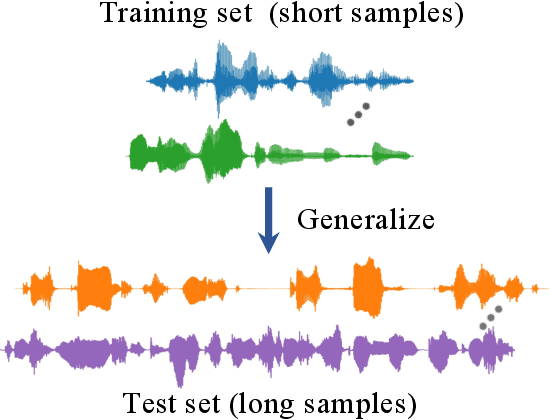
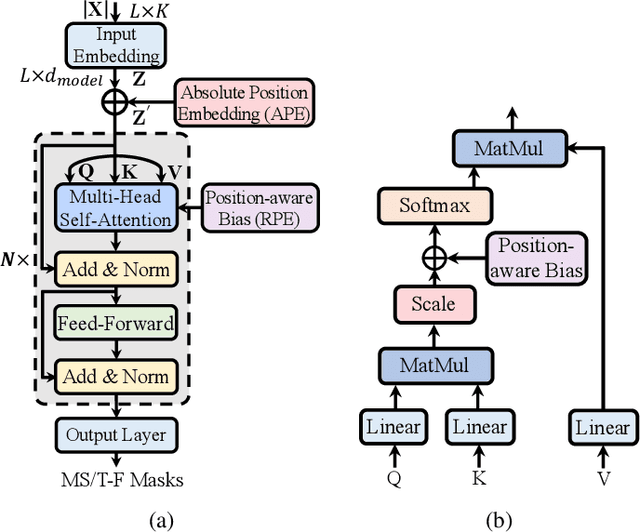
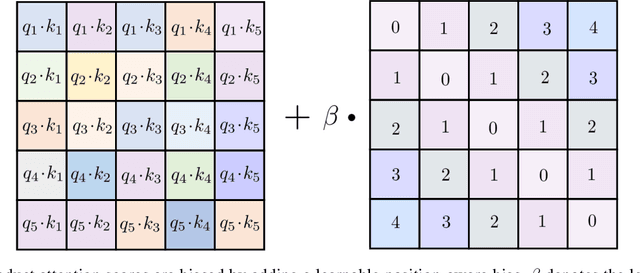
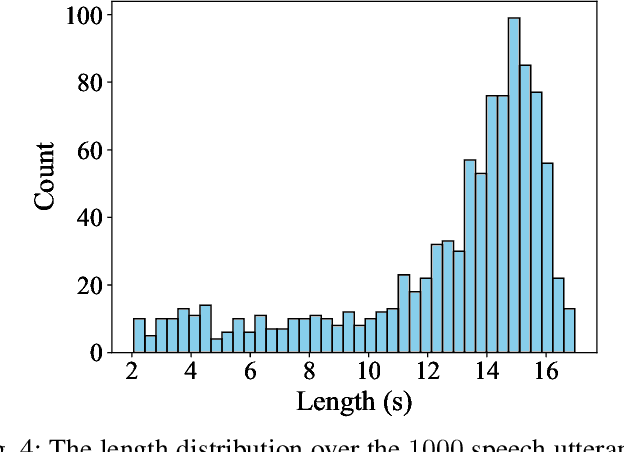
Transformer network architecture has proven effective in speech enhancement. However, as its core module, self-attention suffers from quadratic complexity, making it infeasible for training on long speech utterances. In practical scenarios, speech enhancement models are often required to perform on noisy speech at run-time that is substantially longer than the training utterances. It remains a challenge how a Transformer-based speech enhancement model can generalize to long speech utterances. In this paper, extensive empirical studies are conducted to explore the model's length generalization ability. In particular, we conduct speech enhancement experiments on four training objectives and evaluate with five metrics. Our studies establish that positional encoding is an effective instrument to dampen the effect of utterance length on speech enhancement. We first explore several existing positional encoding methods, and the results show that relative positional encoding methods exhibit a better length generalization property than absolute positional encoding methods. Additionally, we also explore a simpler and more effective positional encoding scheme, i.e. LearnLin, that uses only one trainable parameter for each attention head to scale the real relative position between time frames, which learns the different preferences on short- or long-term dependencies of these heads. The results demonstrate that our proposal exhibits excellent length generalization ability with comparable or superior performance than other state-of-the-art positional encoding strategies.
FIGhost: Fluorescent Ink-based Stealthy and Flexible Backdoor Attacks on Physical Traffic Sign Recognition
May 17, 2025Traffic sign recognition (TSR) systems are crucial for autonomous driving but are vulnerable to backdoor attacks. Existing physical backdoor attacks either lack stealth, provide inflexible attack control, or ignore emerging Vision-Large-Language-Models (VLMs). In this paper, we introduce FIGhost, the first physical-world backdoor attack leveraging fluorescent ink as triggers. Fluorescent triggers are invisible under normal conditions and activated stealthily by ultraviolet light, providing superior stealthiness, flexibility, and untraceability. Inspired by real-world graffiti, we derive realistic trigger shapes and enhance their robustness via an interpolation-based fluorescence simulation algorithm. Furthermore, we develop an automated backdoor sample generation method to support three attack objectives. Extensive evaluations in the physical world demonstrate FIGhost's effectiveness against state-of-the-art detectors and VLMs, maintaining robustness under environmental variations and effectively evading existing defenses.
Audio-Visual Class-Incremental Learning for Fish Feeding intensity Assessment in Aquaculture
Apr 21, 2025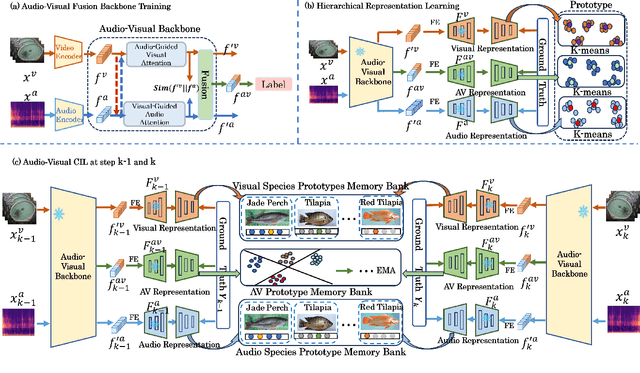
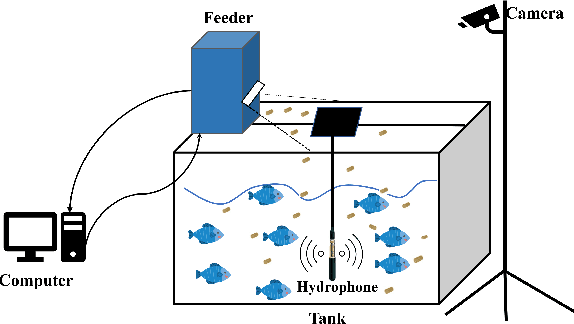
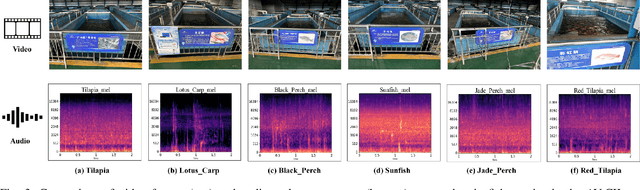
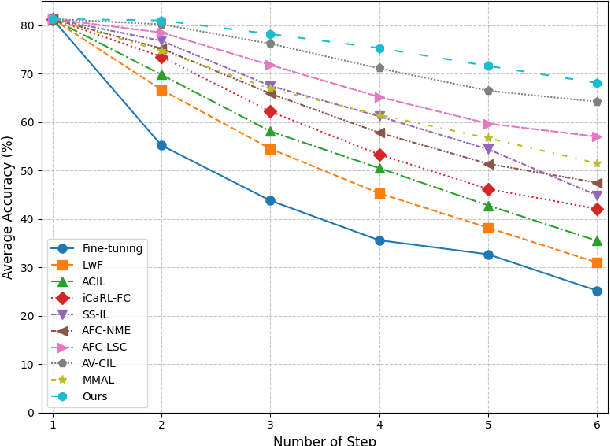
Fish Feeding Intensity Assessment (FFIA) is crucial in industrial aquaculture management. Recent multi-modal approaches have shown promise in improving FFIA robustness and efficiency. However, these methods face significant challenges when adapting to new fish species or environments due to catastrophic forgetting and the lack of suitable datasets. To address these limitations, we first introduce AV-CIL-FFIA, a new dataset comprising 81,932 labelled audio-visual clips capturing feeding intensities across six different fish species in real aquaculture environments. Then, we pioneer audio-visual class incremental learning (CIL) for FFIA and demonstrate through benchmarking on AV-CIL-FFIA that it significantly outperforms single-modality methods. Existing CIL methods rely heavily on historical data. Exemplar-based approaches store raw samples, creating storage challenges, while exemplar-free methods avoid data storage but struggle to distinguish subtle feeding intensity variations across different fish species. To overcome these limitations, we introduce HAIL-FFIA, a novel audio-visual class-incremental learning framework that bridges this gap with a prototype-based approach that achieves exemplar-free efficiency while preserving essential knowledge through compact feature representations. Specifically, HAIL-FFIA employs hierarchical representation learning with a dual-path knowledge preservation mechanism that separates general intensity knowledge from fish-specific characteristics. Additionally, it features a dynamic modality balancing system that adaptively adjusts the importance of audio versus visual information based on feeding behaviour stages. Experimental results show that HAIL-FFIA is superior to SOTA methods on AV-CIL-FFIA, achieving higher accuracy with lower storage needs while effectively mitigating catastrophic forgetting in incremental fish species learning.
FaceSpeak: Expressive and High-Quality Speech Synthesis from Human Portraits of Different Styles
Jan 02, 2025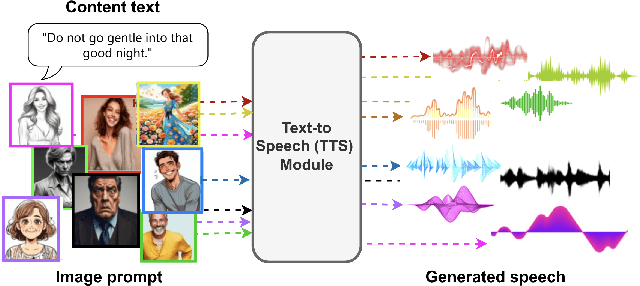


Humans can perceive speakers' characteristics (e.g., identity, gender, personality and emotion) by their appearance, which are generally aligned to their voice style. Recently, vision-driven Text-to-speech (TTS) scholars grounded their investigations on real-person faces, thereby restricting effective speech synthesis from applying to vast potential usage scenarios with diverse characters and image styles. To solve this issue, we introduce a novel FaceSpeak approach. It extracts salient identity characteristics and emotional representations from a wide variety of image styles. Meanwhile, it mitigates the extraneous information (e.g., background, clothing, and hair color, etc.), resulting in synthesized speech closely aligned with a character's persona. Furthermore, to overcome the scarcity of multi-modal TTS data, we have devised an innovative dataset, namely Expressive Multi-Modal TTS, which is diligently curated and annotated to facilitate research in this domain. The experimental results demonstrate our proposed FaceSpeak can generate portrait-aligned voice with satisfactory naturalness and quality.
Breaking Through the Spike: Spike Window Decoding for Accelerated and Precise Automatic Speech Recognition
Jan 01, 2025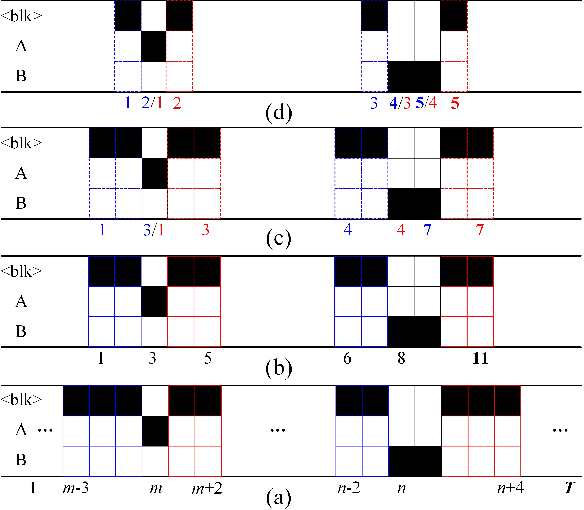
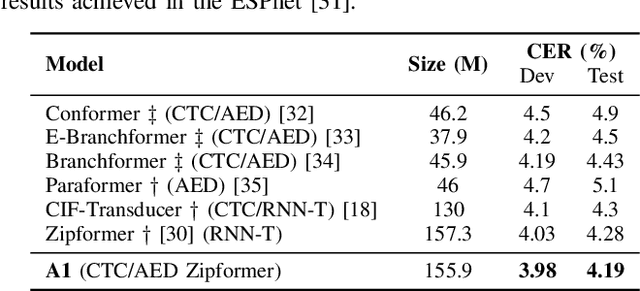
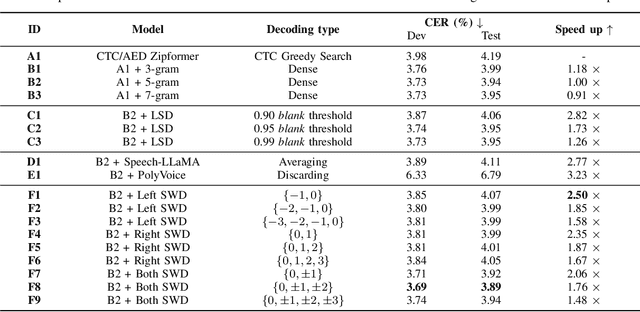
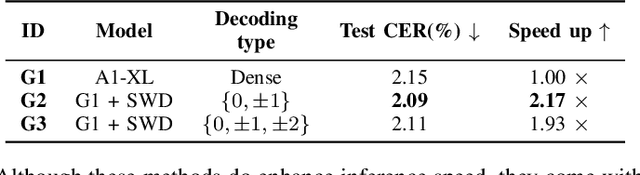
Recently, end-to-end automatic speech recognition has become the mainstream approach in both industry and academia. To optimize system performance in specific scenarios, the Weighted Finite-State Transducer (WFST) is extensively used to integrate acoustic and language models, leveraging its capacity to implicitly fuse language models within static graphs, thereby ensuring robust recognition while also facilitating rapid error correction. However, WFST necessitates a frame-by-frame search of CTC posterior probabilities through autoregression, which significantly hampers inference speed. In this work, we thoroughly investigate the spike property of CTC outputs and further propose the conjecture that adjacent frames to non-blank spikes carry semantic information beneficial to the model. Building on this, we propose the Spike Window Decoding algorithm, which greatly improves the inference speed by making the number of frames decoded in WFST linearly related to the number of spiking frames in the CTC output, while guaranteeing the recognition performance. Our method achieves SOTA recognition accuracy with significantly accelerates decoding speed, proven across both AISHELL-1 and large-scale In-House datasets, establishing a pioneering approach for integrating CTC output with WFST.